


Rolling, Sliding and Automatic Gates: What to Compare

A rolling slide gate is a form of sliding gate. Automatic describes powered operation, which can be used with a suitable sliding or swing design. To choose a fence gate, compare its movement, support system and operating method separately.
Correction: An earlier version of this article said rolling fence gates roll back onto themselves and need minimal side space. That was inaccurate for conventional single-panel rolling slide gates: the gate leaf travels sideways and needs space when open.
Updated October 13, 2026.
Start with three separate choices
- Movement: Does the proposed gate swing on hinges or slide along the entrance line?
- Support: For a sliding design, what wheels, track or cantilever system will carry and guide the gate?
- Operation: Will someone move it manually, or will a compatible powered operator move it?
This avoids comparing overlapping labels as if they were three competing products. For example, TYMETAL classifies V-groove rolling and cantilever designs as slide gates, and describes both manual and automated applications.
Compare where the gate goes when open
A swing gate needs a clear area for its opening motion. A sliding gate needs a clear route beside the opening. Nice | HySecurity’s gate overview distinguishes these two movements. A short driveway does not, by itself, prove that a particular sliding design will fit.
For either layout, ask to see the proposed fully open position and the whole path between open and closed. Show the estimator where vehicles wait, where people walk, and where you normally keep bins or equipment. Include the approach and turning route for a trailer or delivery vehicle if that access matters to you.
Track-supported rolling slide gates
In a V-groove arrangement, wheels support the gate on a ground track; DoorKing’s V-wheel hardware is an example. The panel still moves horizontally. Review the track route, surrounding surface and maintenance access with the proposed system; a rolling label does not mean that the gate coils up or needs no storage space.
Cantilever slide gates
A cantilever design carries the gate from supports beside the opening without a ground track crossing the opening. Its counterbalance section adds panel length, which must be included in the layout. TYMETAL explains this support arrangement. The exact space follows the selected design, rather than a universal rule.
Specialty telescoping roller designs use a different panel arrangement and storage footprint. Do not transfer their space requirements to an ordinary single-panel gate. Ask for a layout based on the actual system being proposed.
Decide how you want to operate it
Describe who will use the entrance and how often. Would you prefer to open it by hand, or do you want to discuss powered access? If you have a gate already, make its condition part of that discussion; adding an operator should not be treated as a remedy for a gate that binds or is damaged.
For a powered vehicle gate, have a trained gate-systems technician assess the complete installation. DASMA’s automatic gate guidance calls for separate pedestrian access, an operator appropriate to the application, and protection addressing the site’s entrapment hazards. One advertised obstacle-detection feature does not replace that review.
Ask for operating and maintenance instructions, a demonstration of the manual disconnect, and a plan for routine safety testing. Discuss how the selected equipment behaves during a power interruption; do not assume that every system has battery backup. If the gate is damaged, difficult to move or its safety systems malfunction, discontinue use and contact a trained technician.
Use real projects to discuss appearance
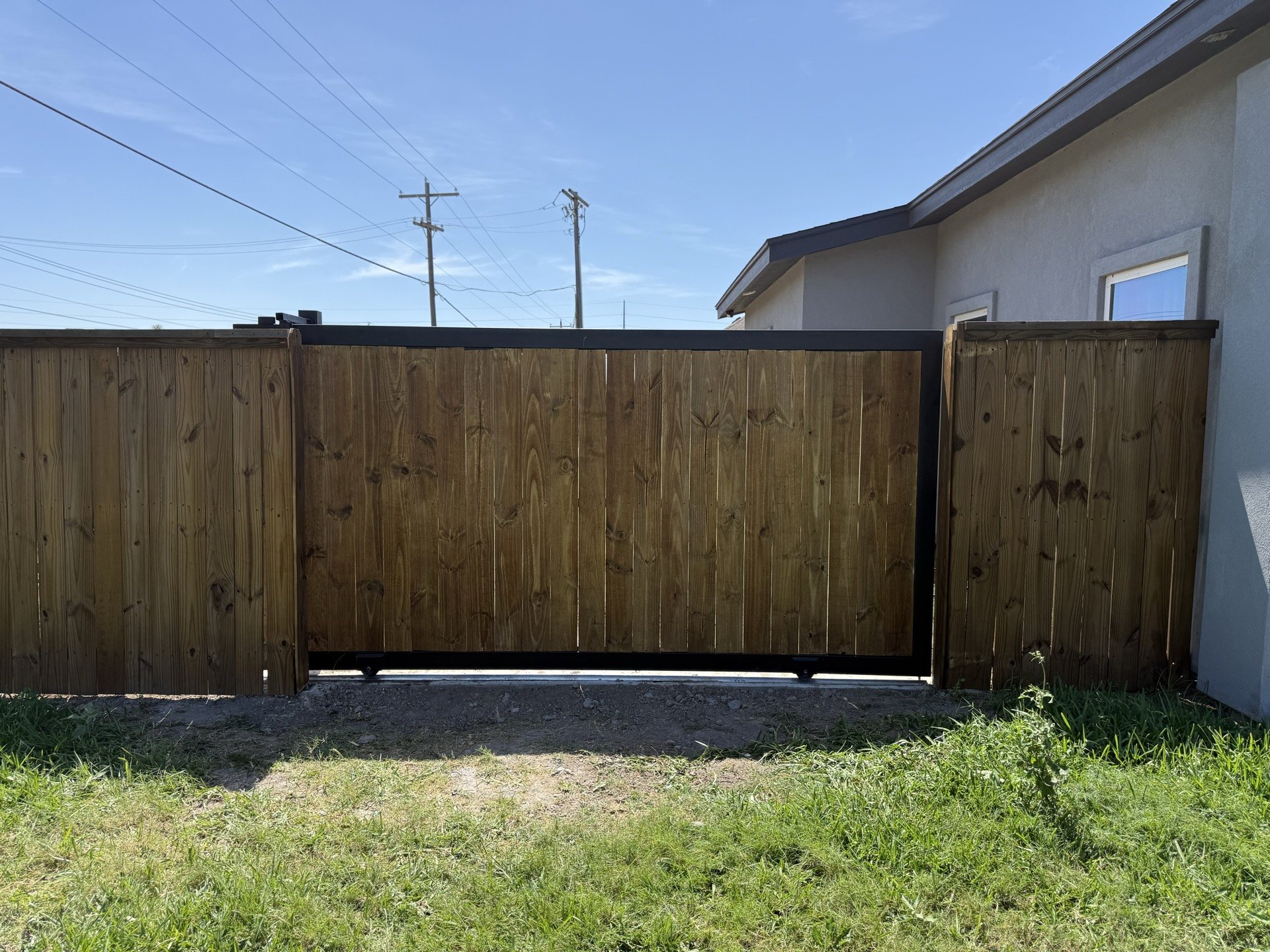
Our Hidalgo wood-infill sliding gate gallery shows wood boards within a dark metal frame. It is a useful reference for the relationship between a gate and the adjoining fence. The photos do not establish opening dimensions, operator equipment or whether that gate is manual or powered.
For another visual direction, the Edinburg arched driveway gate gallery shows ornamental bars and a solid lower panel between stone columns. Choose the look you want while reviewing movement and operation separately.
The existing Hidalgo sliding-gate planning guide explores that project’s surrounding space, and the Edinburg ornamental-gate guide focuses on appearance. Those examples complement this general comparison.
Bring these details to your estimate
- Photos of the entrance from both sides, including the adjoining fence line.
- The vehicles, people and deliveries that need access.
- Where you park, wait and store items near the gate’s proposed travel path.
- Your preferred appearance and whether manual or powered operation is being considered.
Request a written proposal that identifies the gate design, support system, finish and operating scope. If automation is included, ask what equipment, power work, safety setup, owner instructions and follow-up service are included. Compare proposals for the same scope rather than assuming one gate label guarantees a lower price or greater security.
See our custom gate service and RGV service areas. To discuss a gate estimate, call Guerrero Fences at (956) 904-0308 or schedule an estimate visit for a city available in the booking form. For another served RGV city, send an estimate request.